From elsewhere on the web. See what helps in your daily work or catches your interest.
People worth following · 6
Sandeep Swadia
Videos about success, work and modern life, plus walkthroughs that teach non-technical people to use Claude Code, AI agents and ChatGPT. His stated path: monk training, MIT, tech CEO.
Why this is a valuable resource: Explains the tools to people who will never open a terminal, out of a career actually lived rather than studied. The making is unusually careful for the genre.
One of the best-known software engineers in artificial intelligence — a founding member of OpenAI and later Director of AI at Tesla.
Why this is a valuable resource: Genuine, generous knowledge-sharing from the very top of the field: he explains even the hardest AI topics in a simple, understandable way.
Professional software engineer covering advanced agentic-engineering topics — typically well ahead of the curve.
Why this is a valuable resource: Talks about advanced topics long before others jump on that train — if you want to see where agentic engineering is heading, he is already there.
A senior software engineer teaching practitioners how to actually use AI — with a clear passion for and focus on agentic coding.
Why this is a valuable resource: No hype, no clickbait — an engineer speaking from real practice. If you work agentically, you will recognize your own experience in what he says, and mostly find yourself agreeing.
AI consultant, not a software engineer — covers the latest AI tools and trends and how to wire them into a working setup, for people who want to apply AI without going deep into the technical layer.
Why this is a valuable resource: Explains well and with real passion. His subject is the tool landscape rather than engineering depth — what is arriving, what it does, how it wires together.
Former Twitch engineer, founder of the Y Combinator startup Ping Labs and the builder behind the T3 Stack, T3 Chat and T3 Code. His YouTube channel covers web development, developer tools and AI-assisted coding.
Why this is a valuable resource: Straight and honest — and a genuinely strong software engineer and architect. He runs agentic engineering in production on his own projects; what he reports comes from that work, not from a quick try-out.
JetBrains' integrated development environment for the JVM and well beyond — debugger, refactorings, static inspections, version control and language tooling in one place.
Why this is a valuable resource: One of the most complete development environments there is, and after years of using it the whole toolset is simply at hand. When something has to be done without an agent, that familiarity is what makes it comfortable.
Voice dictation for anywhere you type — it transcribes speech straight into the active text field and corrects the grammar on the way in.
Why this is a valuable resource: Dictation only pays off when there is nothing left to fix afterwards, and this one holds up: it stays on the right voice in a noisy room or with other people talking nearby, and it is configurable enough to fit an actual working setup. Speaking is far faster than typing — this is what makes that difference usable.
Anthropic's agentic coding tool — built with a genuine focus on software development and engineering.
Why this is a valuable resource: My main coding tool for years. What sets it apart: Anthropic builds for software engineers first, and it shows in how the tool fits real engineering work.
Kent Beck: Software Engineering in the Age of AI | Prodacity 2026
A 52-minute talk from Prodacity 2026 in which Kent Beck, creator of Extreme Programming and a pioneer of test-driven development, shows how he builds software with AI agents today.
Why this is a valuable resource: One of the people who shaped how software gets built works with agents himself and says plainly where they go wrong and what they give him. Short on time? The last 15 minutes are enough.
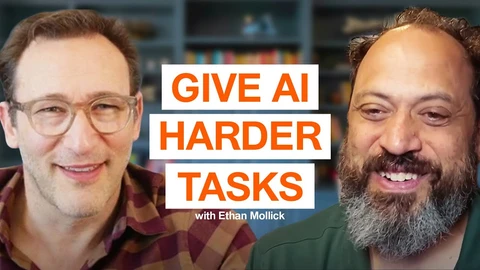
The AI Skills Nobody is Teaching (And Everyone Needs)
A long-form conversation between Simon Sinek and Wharton professor Ethan Mollick on what integrating AI into everyday work actually looks like: where human agency has to stay, how personal taste develops, and which professional skills are shifting.
Why this is a valuable resource: Mollick gives the upside and the damage the same weight, and stays concrete about what AI plausibly changes for how people learn and work.